8th von Baer Seminar 2026
Full day conference & Gala Dinner
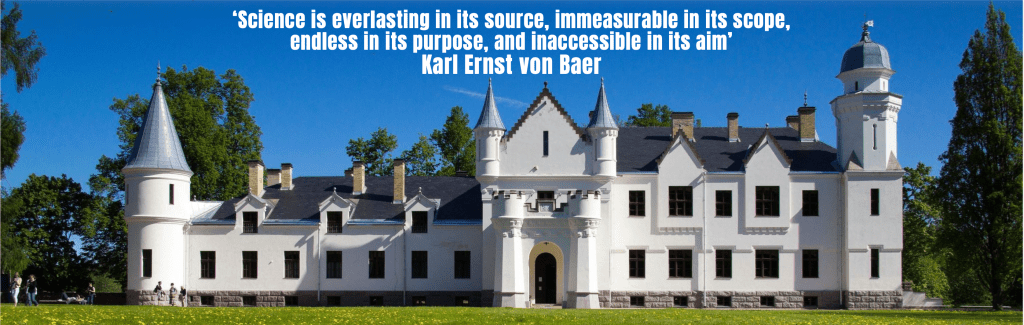
Alatskivi Castle (Peipsiääre Parish, Estonia)
Transport included
EVENT PROGRAM
POSTER EXHIBITION
- One Diagnosis, Different Microbiomes: Towards Microbiome-Informed Management of Bacterial Vaginosis – Merli Saare (University of Tartu & CELVIA)
- Validation of molecular and functional endpoints for assessing phthalate exposure effects in the human ovary – Alesandro Haxhiu (Karolinska Institutet)
- A successful pregnancy in a T-shaped uterus – the pivotal role of the endometrial competence versus the uterine volume – Nadezhda Milova (Center for Womens Health, Plovdiv)
- Trans-acting factors in circRNA biogenesis – novel biomarkers and potential therapeutic targets for receptive and cancerous endometrium – Maria Nikolova (Center for Womens Health, Plovdiv)
- In Vitro Reconstruction of Receptive Human Endometrium for Blastoid attachment – Kristina Hansing (Karolinska Institutet)
- Shared and condition-specific genetic architecture linking reproductive disorders with insomnia, pain and depression – Vijayachitra Modhukur (University of Tartu & CELVIA)
- F64: a rapid customizable metagenome sequencing data filter – Alars Aints (University of Tartu)
September 11th 2026
09:30-10:00: Registration & Coffee
10:00-10:15: The von Baer Seminar
Dr. Andres Salumets (President of Baltic Fertility Society) & Dr. Alberto Sola-Leyva (Organizing committee)
Andres is the member of the board of CELVIA and a professor of reproductive medicine at the University of Tartu and the Swedish Karolinska Institute. He obtained his doctorate at the University of Helsinki. Andres is one of the leading reproductive medicine researchers in the Baltics and Scandinavia. As an active researcher, he has published over 200 articles and actively participates in several international collaborations.
Alberto is researcher at CELVIA and Karolinska Institutet. He completed his PhD at the University of Granada (Spain), where he investigated the role of microbes in female reproduction. His current research focuses on the use of advanced in vitro models and multi-omics techniques to unravel potential factors that can influence embryo implantation. Coordinator of the Special Interest Group in Reproductive Genetics at ESHRE.
Session 1
Chair: Apostol Apostolov
10:15-10:45: Clinical application of endometrial microbiome analysis in human reproduction: myths and realities
Dr. Alberto Sola-Leyva (CELVIA, Estonia & Karolinska Institutet, Sweden)
Dr Sola-Leyva is a Principal Investigator at CELVIA and Assistant Professor at Karolinska Institutet. He completed his PhD at the University of Granada (Spain), where he investigated the role of microbes in female reproduction. His current research focuses on the use of advanced in vitro models and multi-omics techniques to unravel potential factors that can influence embryo implantation. Coordinator of the Special Interest Group in Reproductive Genetics at ESHRE.
10:45-11:15: Embryo Interactome at Genomic and Transcriptomic Levels
Dr. Amruta Pathare (CELVIA, Estonia & Karolinska Institutet, Sweden)
Dr Amruta Pathare is a Senior Researcher at Karolinska Institutet, Sweden, and a Co-Principal Investigator at Celvia CC AS, Estonia. Her research focuses on endometrial biology, embryo implantation, reproductive disorders, and the molecular mechanisms affecting fertility and pregnancy outcomes. Her work integrates transcriptomics, single-cell analysis, functional genomics, organoid and embryo–endometrium models, and computational approaches to study reproductive health.
11:15-11:45: Regulators of Embryonic Genome Activation in Bovine IVF Embryos
Dr. Baris Yasar (CELVIA, Estonia)
Barış Yaşar received his Bachelor of Science (B.Sc.) degree in Molecular Biology and Genetics from Bilkent University, Ankara, Turkey, in 2014. He then joined the Molecular Biosciences degree programme at Heidelberg University, Germany, where he received his Master of Science (M.Sc.) degree in 2017 and continued to work as a Research Assistant. In 2020, he began his doctoral studies through a joint Ph.D. programme between the University of Tartu and Karolinska Institutet as part of the European Union’s Horizon 2020 Marie Skłodowska-Curie Actions. He received his doctoral degrees from the University of Tartu and Karolinska Institutet in 2026. His doctoral research focused on early embryo development and embryonic genome activation (EGA), using bovine embryos as a model organism. He combined molecular cloning, transcriptomic profiling, and computational and evolutionary analyses to characterize genes and regulatory elements involved in bovine EGA, particularly PRD-like homeobox transcription factors and their regulation during preimplantation development.
11:45-13:00 Lunch break and poster exhibition
13:00-14:00 Session 2 – Selected Oral Presentations
Chair: Kasun Godagedara
Multi-omics profiling of chronic endometritis reveals transcriptionally active microbial signatures and immune remodeling
Lucía Blanco Rodríguez (University of Tartu, CELVIA, Karolinska Institutet)
Validation of ovarian tissue cryopreservation in a newly established cryobank: a practical framework for implementation and quality control
Dr. Agnė Kozlovskaja-Gumbrienė (Lithuanian University of Health Sciences)
Turning off the ovaries: what happens during the perimenopausal transition
Dr. Ilmatar Rooda (Karolinska Institutet)
PRS-wide association study analysis provides insight into the genetic background of hormone sensitivity-related diagnoses in women
Anastasiia Bratchenko (University of Tartu)
Decoding the regulatory genetic architecture of endometriosis using AlphaGenome
Dr. Sanu Bifal (CELVIA)
Genome-wide analysis of 64 male reproductive phenotypes reveals novel loci and shared biological pathways
Jéssica Figuerêdo (University of Tartu)
Session 3
Chair: Apostol Apostolov
14:00-14:30: The Essential Role of Hysteroscopy in Infertility Management
Dr. Nataliia Kotsabyn (Medical Center of Human Reproduction “DAMIA” in Ivano-Frankivsk, Ukraine)
Nataliya Kotsabyn, MD, PhD is a gynecologist-reproductive specialist, ultrasound specialist and geneticist from Ukraine. President of the Ukrainian Hysteroscopy Association and head doctor of Medical Center of Human Reproduction “DAMIA” in Ivano-Frankivsk. She specializes in hysteroscopy, recurrent implantation failure (RIF), adenomyosis, and reproductive endocrinology. She organizes international training courses and conferences in hysteroscopy and ultrasound, including OPUS LAB programs.
14:30-15:00: Mapping the spectrum and origins of aneuploidies in pregnancy loss across gestation
Dr. Pol Solé (University of Gothenburg, Sweden)
Pol Solé-Navais is a group leader at the Wallenberg Laboratory, University of Gothenburg (Sweden), with extensive experience in international collaborative genetic efforts. By integrating computational biology with large-scale genetic and registry data, we aim to understand the mechanisms behind pregnancy loss and other pregnancy and neonatal outcomes. Our ultimate goal is to transform reproductive biology, advance molecular diagnostics and understand the fundamental mechanisms behind human development through the lens of genetic variation.
15:00-15:30: Coffee break and poster exhibition
Session 4 (Session concept from the NESTOR project)
Chair: Alberto Sola-Leyva
15:30-16:00: Cell-Free DNA analysis for pregnancies and policy proposals for NIPT implementation in Estonia
Dr. Kaarel Krjutškov (CELVIA & University of Tartu, Estonia)
Dr. Krjutškov is a scientist and inventor in the field of genetic engineering. Head of the Laboratory at CELVIA CC and Associate Professor at University of Tartu. He got his doctorate in molecular diagnostics at the University of Tartu and then worked at the Swedish Karolinska Institute and the University of Helsinki. Kaarel is the pioneer and developer of the NIPTIFY Focus Plus test. He has published over 60 scientific articles and is an associate professor of molecular medicine at the University of Tartu.
16:00-16:30: Transition of Atrioventricular Conduction from Embryonic to Fetal Stage of Human Intrauterine Development
Dr. Ganesh Acharya (Karolinska Instituet, Sweden)
Prof. Ganesh Acharya, MD, PhD, FRCOG, is Head of the Division of Obstetrics & Gynaecology and Director of the Centre for Embryonic and Prenatal Precision Medicine at Karolinska Institutet, as well as Senior Consultant at the Centre for Fetal Medicine, Karolinska University Hospital in Stockholm. He trained in medicine and obstetrics and gynaecology across Ukraine, Nepal, the UK, Norway, and the USA, and holds additional qualifications in medical imaging, fetal medicine, and perinatal cardiology. With extensive international clinical and academic experience, he was appointed Professor at the University of Tromsø in 2008 and at Karolinska Institutet in 2016. He also served as Editor-in-Chief of Acta Obstetricia et Gynecologica Scandinavica from 2015 to 2025. His research spans obstetrics and gynaecology, with a particular focus on embryonic and fetal development, cardiovascular physiology, and prenatal medicine.
16:30-17:00: Pregnancy and Complement system
Dr. Inkeri Lokki (Helsinki University, Finland)
17:00-17:30: Coffee break and poster exhibition
Session 5
Chair: Artjom Stepanjuk
17:30-18:00: Automation vs De/Humanization in Assisted Reproduction
Dr. Jose A. Horcajadas (Pronacera, Spain)
He holds a degree in Molecular Biology and Biochemistry from Universidad Autónoma de Madrid (1993) and a PhD from the same university (2000), where he conducted research in virology under Dr. Margarita Salas. He later served as Scientific Director of Fundación IVI and was a founder and CSO of iGenomix. Since 2011, he has combined academic and entrepreneurial activities, holding positions in Genetics at Pablo de Olavide University and Loyola University in Seville while founding several biotechnology and health-related companies, including Recombine Europe, iGLS, SINAE, Fullgenomics, Overture Life, and HoMu Health Ventures. His research focuses primarily on the molecular basis of endometrial receptivity and reproductive medicine, with around 60 scientific publications, six patents, and more than 15 books and book chapters. Throughout his career, he has worked at several leading universities and research institutions across Spain, Germany, the UK, Brazil, and the United States.
18:00-18:30: Von Baer and the science of his time
Dr. Edit Talpsepp (University of Tartu, Estonia)
Edit Talpsepp is a philosopher of biology and science populariser. She did her PhD at the university of Bristol and is currently working as a research fellow and acting head of chair of philosophy of science at the university of Tartu. Her main research interests are essentialist thinking in biology, biological systematics, the relationship between biological claims and socio-political reasoning, history of biology and astrobiology. She has also written numerous popular science articles on the philosophical questions in biology.
18:30-18:45: Closing remarks – José Carlos Esteso Lema (Deputy Head of Mission, The Embassy of Spain in Tallinn)
18:45-19:30: Tour in the Alatskivi Castle
20:00-23:00: GALA DINNER & AWARDS Dr. Andres Salumets (President of Baltic Fertility Society) (Alatskivi Castle)
Baltic Soul, Flamenco Fire: A Live Flamenco Performance


Funded by the European Union. Views and opinions expressed are however those of the author(s) only and do not necessarily reflect those of the European Union or the European Research Executive Agency (REA). Neither the European Union nor the granting authority can be held responsible for them.
 vonbaerseminar.com